
How to Jump-Start a Motorcycle Safely: What Sydney Riders Need to Know
A dead motorcycle battery can leave you stranded in a driveway, car park or on a busy Sydney road. Knowing how to jump-start a motorcycle can help you understand whether a jump is appropriate and what precautions to take before connecting a power source.
Motorcycle batteries are smaller than many car batteries, and different bikes can use different battery technologies and specifications. If your motorcycle will not start, begin by checking whether the battery is actually the problem rather than immediately connecting jumper cables.
For riders who need roadside assistance, Sydney towing services can provide practical help when a motorcycle cannot be safely restarted or ridden.
Check the Motorcycle Before Attempting a Jump Start
A motorcycle that will not start does not automatically have a flat battery. Electrical faults, a failed starter motor, charging problems, fuel issues and other mechanical faults can create similar symptoms.
Before attempting a jump, take a few moments to assess the motorcycle and make sure the situation is safe. If you are stopped near moving traffic, your personal safety should come before trying to repair the bike.
Look for Signs of a Weak Battery
Turn the ignition on and observe the electrical system. A dim instrument display, weak lights or a starter motor that turns slowly can indicate that the battery does not have enough charge.
You may also hear a clicking sound when pressing the starter button. While these symptoms can point towards a weak battery, they do not prove that the battery is the only problem.
If the motorcycle has been sitting unused for an extended period, battery discharge is more likely. However, repeated battery failures may indicate an underlying charging or battery condition that needs attention.
Inspect the Battery and Connections
Before connecting anything, check the battery for obvious damage. Do not attempt a jump if the battery is cracked, swollen, leaking or otherwise visibly damaged.
Also check the terminals and cables for loose connections, severe corrosion or damaged wiring. A poor connection can prevent the motorcycle from starting and may create additional electrical risks during a jump attempt.
If you cannot identify the battery terminals or are unsure about the motorcycle’s electrical system, check the owner’s manual before proceeding.
How to Jump-Start a Motorcycle With Cables
If the battery appears suitable for a jump and you have compatible equipment, jumper cables can provide temporary starting power. The motorcycle manufacturer’s instructions should always take priority because battery locations, terminals and recommended procedures can vary between models.
Do not treat a motorcycle jump start exactly like starting a car. The battery, electrical system and available starting current can be different, so using unsuitable equipment can create unnecessary problems.
Prepare Both Vehicles or Batteries
If you are using another vehicle’s battery, park both vehicles safely and keep them from touching. Turn both ignition systems off before making the connections.
Make sure the assisting battery is compatible with the motorcycle’s electrical system. Never assume that a larger vehicle battery is automatically suitable simply because it can provide more starting power.
Connect the Cables Carefully
The general connection sequence for a compatible system is:
- Turn both vehicles or systems off.
- Connect the red positive clamp to the motorcycle’s positive terminal.
- Connect the other red clamp to the positive terminal of the assisting battery.
- Connect the black clamp to the assisting battery’s negative terminal.
- Connect the remaining black clamp to the motorcycle’s recommended negative terminal or suitable ground point.
- Check that the clamps are secure and correctly positioned.
Do not allow the clamps to touch each other once they are connected to a power source. Incorrect polarity can damage electrical components, so stop immediately if you are uncertain about which terminal is positive or negative.
Try Starting the Motorcycle
Once everything is connected correctly, try starting the motorcycle. Avoid holding the starter continuously if the engine does not respond.
A short starting attempt is preferable to repeatedly cranking the engine. If the motorcycle does not start after a suitable attempt, stop rather than repeatedly applying power without understanding the cause.
If the engine starts, disconnect the cables carefully according to the equipment or motorcycle manufacturer’s instructions.
How Many Amps to Jump Start a Motorcycle?
There is no single amp figure that applies to every motorcycle. The answer to how many amps to jump start a motorcycle depends on the motorcycle, its battery, its starting requirements and the jump-start equipment being used.
Cold Cranking Amps, commonly abbreviated as CCA, describe a battery’s ability to provide starting current under specified test conditions. This rating is useful when comparing batteries, but it does not mean you should simply select the biggest jump starter available.
The important considerations include the motorcycle’s battery voltage, battery type, manufacturer’s specifications and the jump starter’s suitability for motorcycle use.
| What to check | Why it matters |
|---|---|
| Battery voltage | The power source must be compatible with the motorcycle |
| Battery type | AGM, conventional and other battery technologies can have different requirements |
| CCA rating | Indicates starting-current capability |
| Jump starter rating | Helps determine whether the equipment is suitable |
| Battery condition | A damaged battery should not simply be boosted |
| Manufacturer instructions | Provides model-specific guidance |
When choosing equipment, match the motorcycle’s specifications rather than relying only on an amp number.
How to Jump-Start a Motorcycle Without Cables
If you are searching for how to jump start a motorcycle without cables, a portable motorcycle-compatible jump starter may be an option.
These compact devices can provide starting assistance without requiring another vehicle. However, they still need to be compatible with your motorcycle’s voltage and battery requirements.
Use a Suitable Portable Jump Starter
Start by checking the jump starter’s instructions and confirming that it is designed for the motorcycle’s electrical system.
A typical process involves:
- Turn the motorcycle off.
- Make sure the portable unit has sufficient charge.
- Connect the positive clamp to the correct positive terminal or approved connection point.
- Connect the negative clamp to the recommended negative terminal or ground point.
- Activate the jump starter according to its instructions.
- Attempt to start the motorcycle.
- Disconnect the equipment using the recommended procedure.
Do not improvise by connecting unsuitable batteries, chargers or electrical equipment. A portable jump starter should be selected according to the motorcycle’s requirements rather than simply its physical size.
Can You Push-Start a Motorcycle?
Some manual motorcycles may be capable of being bump-started if sufficient electrical power remains for the ignition and other systems. However, this method is not suitable for every motorcycle or every situation.
It can also be difficult to perform safely, particularly on a busy road, steep surface or slippery area. If you cannot maintain full control of the motorcycle, do not attempt a push start.
What If the Motorcycle Still Will Not Start?
A successful jump start can temporarily restore enough power to start the engine, but it does not repair a failed battery or another mechanical or electrical fault.
If the motorcycle still refuses to start, avoid repeatedly attempting to crank it. Continuing to apply power will not necessarily solve a problem caused by the starter, fuel system, ignition, charging system or another component.
When a Jump Start Has Failed
If the battery has been boosted correctly and the motorcycle still will not start, consider whether the problem may be elsewhere. A completely failed battery may also refuse to hold enough charge even after a successful initial start.
Warning signs that you may need further assistance include:
- The starter remains completely inactive
- The motorcycle starts but immediately stops
- The battery becomes flat again shortly afterwards
- Electrical components behave abnormally
- Warning lights appear
- There is a burning smell
- The battery shows visible damage
- The motorcycle has suffered accident damage
At this point, another jump attempt may not be the right solution.
When Motorcycle Towing Is Safer
If your motorcycle cannot be started or is unsafe to ride, professional Motorcycle Towing can provide a safer way to move it to a mechanic, home or another suitable destination.
Towing is particularly useful after an accident, mechanical failure or electrical fault. It also avoids the temptation to ride a motorcycle that has not been properly checked after a serious problem.
For motorcycles that require secure loading and full support during transport, the towing method should be appropriate for the bike and its condition.
What to Do If Your Motorcycle Breaks Down in Sydney
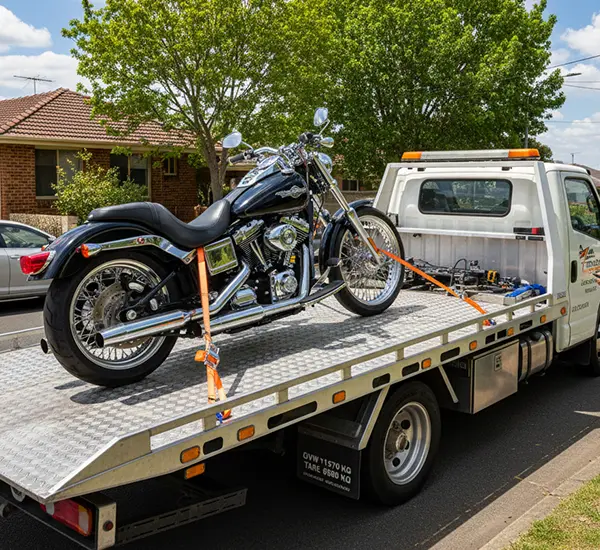
Where your motorcycle stops can be just as important as why it stopped. A dead battery in your garage is very different from a motorcycle that suddenly loses power on a busy Sydney road.
If you are stopped in traffic, move yourself and the motorcycle to the safest position possible without creating another hazard. Turn on appropriate warning lights where available and remain aware of surrounding traffic.
If the location is unsafe, do not spend unnecessary time attempting a DIY repair. Arrange assistance and provide your exact location so the operator can find you efficiently.
If you only need battery assistance, a professional Jump Start service may be able to get the motorcycle running. If the motorcycle cannot be safely restarted, towing can provide the next step.
How to Jump-Start a Motorcycle Battery Safely
Learning how to jump start a motorcycle battery is useful, but knowing when not to attempt one is equally important.
Never try to boost a battery that is visibly cracked, swollen or leaking. Battery problems can involve electrical hazards and, depending on the battery type and condition, other safety concerns.
You should also stop if you notice smoke, excessive heat, unusual smells or sparking. Do not continue connecting or disconnecting cables while the system is producing unexpected electrical activity.
If you are unsure about the battery type, terminal configuration or correct voltage, check the motorcycle owner’s manual or seek professional assistance.
What Happens After a Successful Jump?
Getting the motorcycle started does not necessarily mean the battery problem has disappeared. If the battery discharged because the bike was left unused, it may simply need proper charging and maintenance.
However, if the battery repeatedly goes flat, there could be an issue with the battery itself or the motorcycle’s charging system. Repeated jump starts should not become a substitute for diagnosing the underlying problem.
If the motorcycle starts successfully, pay attention to how it behaves afterwards. Slow starting, unusual electrical behaviour or another flat battery soon after the jump are reasons to have the system checked.
How to Prevent Motorcycle Battery Problems
Battery maintenance can reduce the chance of being stranded with a motorcycle that will not start. This becomes especially important if the bike is used occasionally or sits unused for long periods.
Maintain the Battery During Storage
Motorcycle batteries naturally lose charge over time, and the rate can be affected by factors such as temperature and electrical devices connected to the bike.
If your motorcycle is stored for an extended period, follow the battery manufacturer’s recommendations for charging and maintenance. Use only a suitable charger or maintainer for the battery type.
Regular checks can also help identify a developing problem before the battery becomes completely flat.
Watch for Repeated Starting Problems
One flat battery may happen because lights were left on or the motorcycle was unused for a long time. Repeated battery discharge, however, deserves further attention.
Keep an eye out for:
- Increasingly slow engine cranking
- Weak electrical components
- Repeated clicking when starting
- A battery that frequently loses charge
- Starting difficulties after short periods of parking
- Electrical warning signs
Addressing these symptoms early may help prevent an unexpected roadside breakdown.
When You Should Arrange Towing Instead
Not every motorcycle starting problem should be solved at the roadside. If the bike has accident damage, a suspected mechanical fault or a battery that is visibly damaged, transporting it may be safer than attempting repeated repairs.
If the motorcycle cannot be ridden safely, Flat Bed Towing can be considered where appropriate for the vehicle and recovery situation. The correct equipment and loading method should always be selected according to the motorcycle’s condition.
The same applies if you are stranded somewhere dangerous. Your priority should be getting yourself out of immediate danger rather than spending a long time troubleshooting the motorcycle.
Final Tips for Sydney Motorcycle Riders
Knowing how to jump-start a motorcycle can be useful when a weak battery is the reason your bike will not start. The safest approach is to identify the likely cause, check the battery condition, use compatible equipment and follow the motorcycle manufacturer’s instructions.
Do not focus only on getting the engine running. If the battery repeatedly fails, the motorcycle has another fault or the location is unsafe, arranging professional assistance can be the more sensible option.
For Sydney riders, keeping your motorcycle details, preferred repairer and roadside assistance contact information readily available can make an unexpected breakdown much easier to manage.
Reliable Motorcycle Battery Care Guidance
For additional information about motorcycle battery specifications, voltage checks, charging, storage and battery maintenance, you can review GS Yuasa’s motorcycle battery care and maintenance guidance. The guidance also emphasises using the correct battery specification and following appropriate safety practices when handling motorcycle batteries.
Frequently Asked Questions
Can I jump-start a motorcycle with a car?
A compatible power source may be suitable in some situations, but you should follow the motorcycle manufacturer’s instructions and ensure the electrical system and equipment are compatible. Do not assume that every car battery or jump-start procedure is appropriate for every motorcycle.
How many amps do I need to jump-start a motorcycle?
There is no universal amp requirement for every motorcycle. The correct equipment depends on the motorcycle’s battery specifications, voltage, starting requirements and the manufacturer’s recommendations.
Can I jump-start a motorcycle without another vehicle?
Yes, a suitable portable jump starter can provide an alternative to using another vehicle. Make sure the unit is specifically suitable for your motorcycle’s electrical system before connecting it.
Why does my motorcycle still not start after a jump?
The battery may be too damaged or discharged to start the engine, or the problem may involve the starter, charging system, ignition, fuel system or another component. If a correct jump attempt does not work, further diagnosis or towing may be required.
Is it safe to ride after jump-starting a motorcycle?
A motorcycle that starts after a jump is not automatically safe to ride. If the battery repeatedly fails, warning lights appear, electrical components behave abnormally or the motorcycle has another known fault, have the bike checked rather than assuming the jump solved the problem.
When should I call for motorcycle towing?
Consider motorcycle towing when the bike cannot be started, has accident or mechanical damage, has a damaged battery, or cannot be safely ridden from its current location. Towing can move the motorcycle to a mechanic, home or another suitable destination without requiring you to ride an unsafe bike.