
Towing a Car With a Tow Bar in NSW: Rules, Checks and Safer Options
Towing a car with a tow bar may look like a straightforward way to move a vehicle that cannot be driven, but there are several things that can go wrong if the vehicle, connection or towing method is unsuitable. Weight limits, steering, brakes, drivetrain design and NSW road rules all need to be checked before the vehicles move.
Sydney roads can make an unsuitable setup even harder to manage because of traffic, hills, intersections and frequent braking. If direct towing is not appropriate for the vehicle, Sydney Tow Trucks can provide professional transport without relying on another passenger vehicle to pull the disabled car.
This guide covers 12 common mistakes drivers should avoid and explains what to check before deciding whether a tow bar arrangement is suitable.
Why Tow Bar Towing Needs Careful Planning
A towbar is only one component of a towing setup. Having a strong or correctly fitted towbar does not automatically mean the towing vehicle can safely or legally pull another car.
NSW Road Rule 294 requires another motor vehicle being towed to remain safely controllable. NSW also has specific requirements covering towing attachment capacity, vehicle weight and the control of a vehicle being towed.
The condition of the disabled vehicle matters just as much as the towing equipment. A car with working steering and brakes presents a very different situation from one with locked wheels, drivetrain problems or steering failure.
12 Common Mistakes When Towing a Car With a Tow Bar
Most problems occur when drivers focus only on getting the disabled vehicle moving. A better approach is to assess the entire towing combination before connecting the vehicles.
1. Assuming Any Tow Bar Can Tow Another Car
One of the biggest mistakes is assuming that a fitted towbar is automatically suitable for pulling another vehicle. Towbars have rated capacities, and those limits should not be exceeded.
Transport for NSW advises that a towbar and coupling must be suitable for the intended load and that their rated capacities should not be exceeded. The towing vehicle itself also has manufacturer limits that need to be considered.
A heavy-duty-looking towbar does not increase the manufacturer’s towing capacity of the vehicle.
2. Ignoring the Towing Vehicle’s Weight Limit
The towing vehicle needs to be capable of handling the weight behind it. NSW rules for applicable vehicles prohibit towing when the laden weight of the towed vehicle exceeds the towing attachment capacity or the applicable maximum towing weight.
Check the owner’s manual or manufacturer specifications rather than relying on a towing figure for a different model, engine or drivetrain.
Important figures may include:
- Manufacturer towing capacity
- Towbar capacity
- Vehicle loaded mass
- Gross Combination Mass where applicable
- Other manufacturer restrictions
Work within the lowest applicable limit rather than choosing whichever rating gives the highest number.
3. Using an Incorrect Attachment Point
The towbar on the towing vehicle is only half of the connection. The disabled car also needs an appropriate point designed for the type of towing being considered.
Do not assume a suspension component, bumper support or convenient metal point can safely be used. Vehicle recovery eyes and towing points can have specific purposes and limitations, so the manufacturer’s instructions should be checked first.
If there is no suitable connection point or you are uncertain how the vehicle should be attached, professional car towing avoids relying on an improvised connection.
4. Towing a Car With Faulty Steering or Brakes
A vehicle that cannot steer or brake properly may be extremely difficult to control while travelling behind another car. This is especially important with direct vehicle-to-vehicle towing.
Under NSW Road Rule 294, where control depends on a person in the towed vehicle, its brakes and steering must be in working order and a licensed person must be in the driver’s seat controlling them. The overall towing operation must also be safe.
Do not assume that a rigid connection solves a steering or braking fault.
5. Ignoring Locked Wheels or Damaged Tyres
A car does not necessarily become suitable for towing simply because it can be attached to another vehicle. Locked wheels, severely damaged tyres or wheel problems can prevent it from rolling normally.
Trying to drag a vehicle with a locked wheel can place additional stress on the tyre, suspension, drivetrain and towing connection. It can also make the combination much harder to control.
When wheel or mechanical problems prevent normal movement, breakdown towing may provide a more appropriate way to get the vehicle to a workshop or another destination.
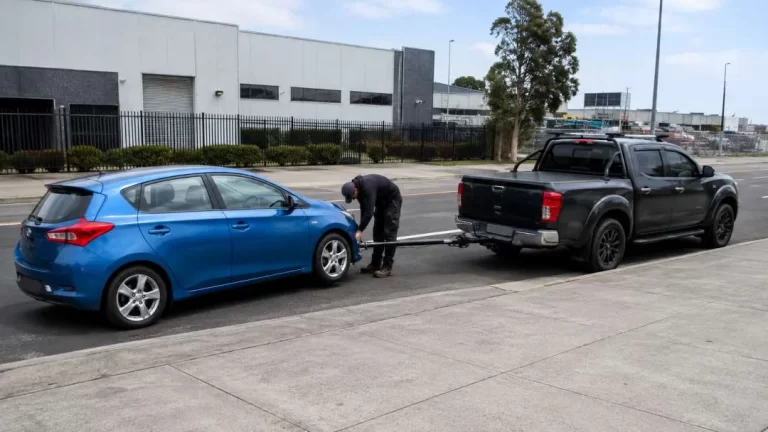
6. Confusing a Tow Bar With an A-Frame Setup
A standard towbar and an A-frame are not the same thing. An A-frame is a triangular attachment used to flat-tow a vehicle behind another vehicle while the towed vehicle remains on its wheels.
Transport for NSW publishes specific VSI 41 guidance covering A-frame towing requirements. Drivers considering this arrangement should check the current guidance for their exact combination rather than assuming that fitting an A-frame automatically makes the setup compliant.
This distinction matters because an A-frame setup can involve requirements different from an ordinary short-distance vehicle tow.
7. Forgetting Automatic Transmission Restrictions
Some automatic vehicles should not travel significant distances with their driven wheels turning while the engine is not operating. The exact limitations vary considerably between manufacturers.
An unsuitable towing method can potentially affect the transmission or other drivetrain components. Before towing a car with a tow bar, check the owner’s manual for instructions covering flat towing, distance and permitted wheel position.
Do not rely on general advice for automatic cars because one transmission design may have very different requirements from another.
8. Flat-Towing an AWD Vehicle Without Checking the Manual
All-wheel-drive vehicles can be particularly sensitive to how their wheels rotate during towing. Allowing some or all wheels to turn while the vehicle is inactive may affect components within the AWD system.
Manufacturer instructions should therefore be checked before flat-towing any AWD vehicle. The correct procedure can depend on the transfer case, transmission and drivetrain design.
If the vehicle should not travel with its wheels turning, tilt tray towing allows the car to be loaded onto a tray instead of remaining on the road throughout the journey.
9. Treating an Electric Vehicle Like a Conventional Car
Electric and hybrid vehicles often have towing instructions that differ from conventional petrol or diesel vehicles. Electric drive motors, parking mechanisms and high-voltage drivetrain components can affect how the vehicle should be moved.
Some manufacturers require particular wheels to remain clear of the road or recommend full vehicle transport except in limited emergency situations. Always check the manufacturer’s recovery instructions for the exact EV or hybrid model.
The safest towing method should be based on the vehicle’s design rather than assumptions made from conventional cars.
10. Exceeding the Towing Attachment Capacity
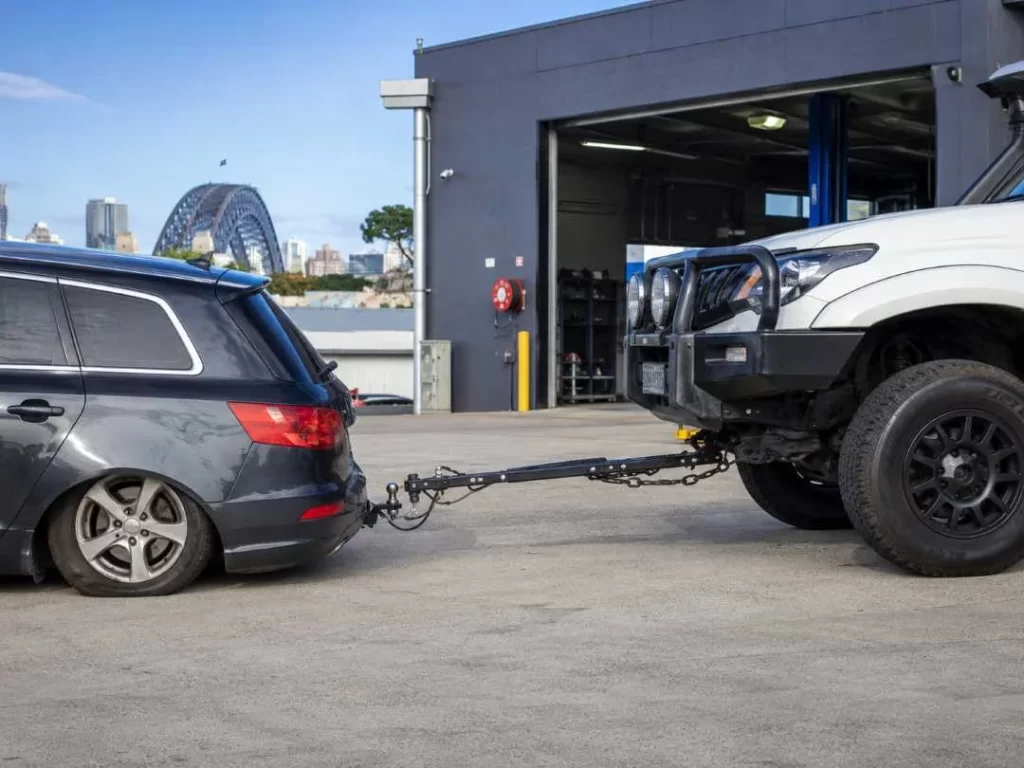
Checking the vehicle’s towing capacity but ignoring the rating of the actual attachment is another common error. Both limits matter.
Transport for NSW states that a towbar and coupling should be of a suitable type and capacity, and their rated capacities should not be exceeded.
For applicable light-vehicle combinations, NSW rules also specifically refer to the capacity of the towing attachment.
This means a vehicle rated to pull a particular weight cannot automatically do so if the fitted towing attachment has a lower rating.
11. Using an Unsuitable Connection Between the Vehicles
The connection needs to keep the towed vehicle controlled throughout the journey. Makeshift equipment or a connection that allows excessive movement can create serious handling problems.
NSW Rule 294-3 generally limits the space between a towing vehicle and another vehicle being towed to 4 metres. Where either vehicle is a motorcycle, the rule specifies 3 metres.
The rule also includes requirements concerning control of a towed motor vehicle. Drivers should therefore check the complete arrangement rather than focusing only on the towbar.
12. Continuing When the Combination Is Difficult to Control
Even when the equipment appears suitable before departure, the towing combination may behave differently once it begins moving. Additional weight can change acceleration, braking and turning behaviour.
If either driver struggles to control the vehicles, continuing simply because the destination is close is a poor approach. Stop somewhere safe where possible and reassess the towing method.
Transport for NSW’s safe towing information notes that towing additional weight changes how a vehicle accelerates, stops and turns, and drivers should allow additional space.
Tow Bar, A-Frame or Professional Towing?
Different transport methods solve different problems. Understanding the basic differences can help you avoid using a tow bar simply because it is already fitted to the vehicle.
| Method | How the vehicle moves | Main consideration |
|---|---|---|
| Direct vehicle towing | Car remains on its wheels | Steering, braking and control must be suitable |
| A-frame towing | Vehicle is flat-towed | NSW A-frame requirements need to be checked |
| Car trailer | Entire car sits on a trailer | Trailer and combination weight limits apply |
| Tilt tray | Car is loaded onto a tilting tray | Avoids travelling on the car’s own wheels |
| Flat-bed transport | Vehicle is carried on the truck | Useful when wheel movement should be avoided |
There is no universal method that suits every vehicle. The vehicle’s condition, weight, drivetrain and manufacturer’s instructions should guide the decision.
For vehicles that should not remain on their wheels during transport, flat bed towing can be an alternative to trying to make a direct tow-bar arrangement work.
When Should You Use a Tow Truck Instead?
Towing a car with a tow bar may be possible in some circumstances when the vehicles, equipment and applicable NSW requirements are suitable. There are also situations where professional transport is considerably more practical.
The main question is whether the disabled vehicle can safely remain part of a two-vehicle combination throughout the journey.
When the car cannot roll or steer normally
Locked wheels, severe tyre damage, steering problems or transmission faults can make conventional towing difficult. The towing vehicle may be capable of pulling the weight, but the disabled car still needs to behave predictably behind it.
Loading the vehicle onto suitable towing equipment removes the need for it to steer, roll or brake as part of the road-going combination.
When the manufacturer restricts flat towing
Automatic, AWD, hybrid and electric vehicles may have specific towing restrictions. Some can only be flat-towed for a limited distance or at a limited speed, while others require a different transport method.
Always follow the instructions for the exact make and model. Manufacturer requirements are more useful than general rules of thumb found online.
When the route makes direct towing impractical
Busy Sydney roads can involve repeated braking, steep sections, roundabouts, lane changes and motorway traffic. Over a longer journey, these demands can become more tiring when controlling a vehicle with additional weight behind it.
Long-distance towing should also include proper route planning and regular rest breaks. Australian Government long-distance driving safety guidance recommends planning ahead and stopping to rest when tired, which is especially important when towing requires greater concentration than normal driving.
For longer or more complicated trips, transporting the disabled vehicle on appropriate towing equipment can avoid many of the difficulties associated with direct towing. It also removes the need for the disabled vehicle to remain safely controlled throughout an extended journey.
Quick Checklist Before You Tow
Before connecting another vehicle, confirm the important details rather than discovering a problem after you have started travelling.
Check:
- The towing vehicle’s rated capacity
- Towbar and attachment ratings
- Loaded weight of the vehicle being towed
- Condition of the steering and brakes
- Wheels and tyres
- Manufacturer flat-towing instructions
- Transmission and drivetrain restrictions
- Suitable towing attachment points
- NSW requirements for the intended arrangement
- The planned route and distance
If any critical requirement is unknown, confirm it before moving the vehicle.
Frequently Asked Questions
Tow bars, direct vehicle towing and A-frame towing are often discussed as though they are the same thing. In practice, the equipment and requirements can vary depending on how the vehicle is actually being moved.
Is towing a car with a tow bar legal in NSW?
It may be permitted when the applicable NSW requirements are met. NSW Road Rules cover control of the towed motor vehicle, towing attachment and weight restrictions, separation between vehicles and other conditions.
A fitted towbar alone does not make every towing arrangement compliant.
Does someone need to be inside the towed car?
For the ordinary situation covered by NSW Rule 294-3, a licensed person generally needs to be in charge of the towed motor vehicle unless an applicable authorisation allows otherwise. Rule 294 also sets requirements where the person in the towed car is relied upon to control its brakes and steering.
Specific approved towing arrangements can have different requirements, so check the rules applying to the setup being used.
Can I tow an automatic car behind another car?
Possibly, but it depends on the manufacturer. Some automatic vehicles permit limited towing with certain wheels on the road, while others require the vehicle to be carried or particular wheels to be lifted.
Check the owner’s manual before towing to avoid possible drivetrain damage.
Can an AWD or 4WD vehicle be flat-towed?
Not automatically. AWD and 4WD drivetrain designs differ, and some manufacturers restrict flat towing because the rotating wheels can affect transmission or transfer-case components.
Follow the exact manufacturer’s instructions for the vehicle.
Is A-frame towing allowed in NSW?
Transport for NSW maintains VSI 41 specifically for A-frame towing and describes it as guidance covering the requirements for flat-towing a motor vehicle using an A-frame.
Check that guidance before setting up an A-frame combination.