Abandoned Vehicle in Strata NSW: Removal Rules and Next Steps
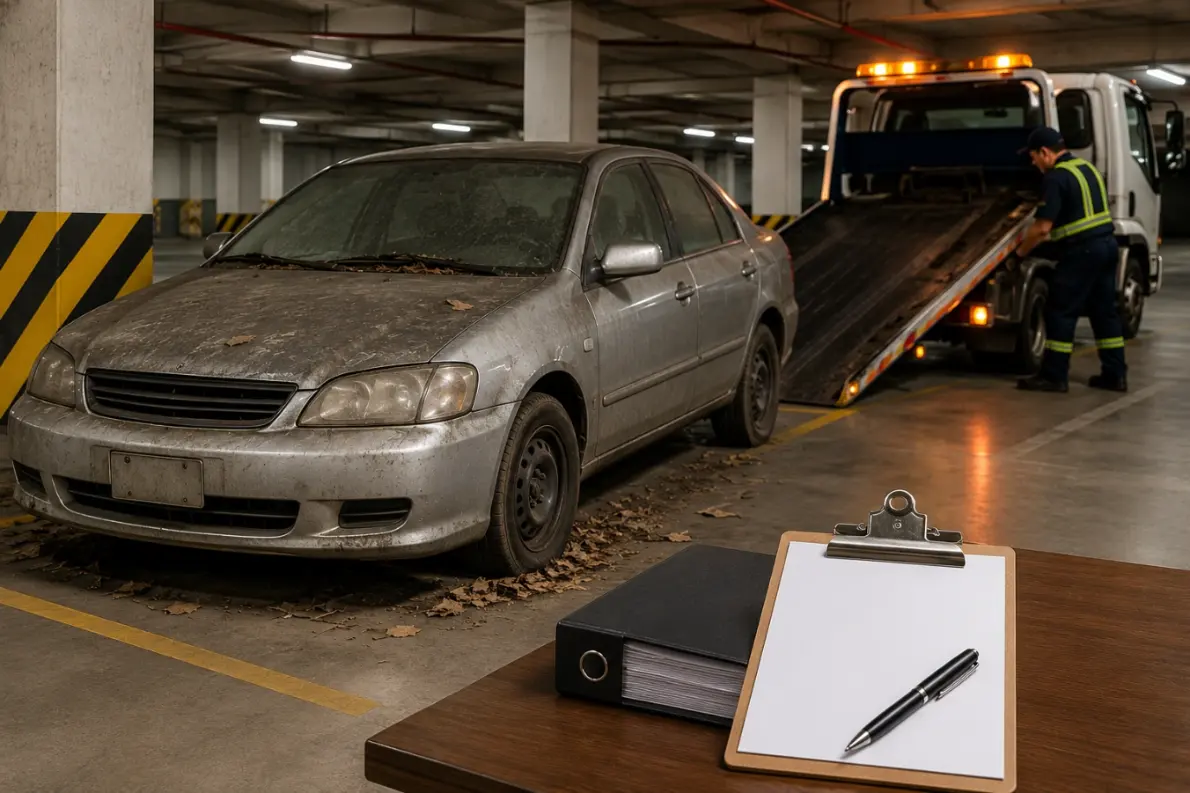
An abandoned vehicle in a strata car park can block access, create safety concerns and cause disputes between residents and the owners corporation. However, a vehicle should not be removed simply because it looks damaged, has expired registration or has remained parked for a long time.
In NSW, strata schemes must distinguish between unauthorised parking, a broken-down vehicle and a vehicle that has genuinely been abandoned. Each situation requires a different response, and removing or disposing of a vehicle without following the correct process may lead to complaints, compensation claims or legal action.
This guide explains the general abandoned vehicle strata NSW process, including notices, ownership checks, towing, storage, disposal and record-keeping.
Is the Vehicle Abandoned or Simply Parked Incorrectly?
The first step is to identify the type of problem. A car can breach a strata parking by-law without being abandoned, while a broken-down vehicle may still have an owner who intends to repair or collect it.
| Situation | What It Usually Means | Appropriate First Response |
|---|---|---|
| Abandoned vehicle | There are reasonable grounds to believe the owner has left it behind. | Begin the applicable uncollected-goods process. |
| Unauthorised parking | The vehicle is still being used but is parked in the wrong place. | Follow the scheme’s parking by-laws. |
| Broken-down vehicle | The owner is known and may be arranging help. | Contact the owner and agree on a removal timeframe. |
| Suspected stolen vehicle | The condition or vehicle details appear suspicious. | Contact NSW Police and do not interfere with it. |
Possible signs of abandonment include long-term inactivity, flat tyres, extensive damage, missing parts and no response from the apparent owner. Expired registration or missing number plates may support further investigation, but neither proves abandonment on its own.
This distinction matters because parking enforcement and the abandoned vehicle process are not the same. Parking breaches are handled through valid strata by-laws, while abandoned vehicles on common property must be managed under the relevant uncollected-goods requirements.
Does the Vehicle Occupy Common Property or a Private Car Space?
Before taking action, the owners corporation should confirm exactly where the vehicle is located.
Common-property areas may include visitor bays, shared driveways, access lanes and loading zones. If a vehicle appears abandoned in one of these areas, the owners corporation may begin the applicable process.
A basement car space is not automatically common property. Some spaces form part of an individual lot, while others are common property subject to exclusive-use rights.
| Vehicle Location | Recommended First Step |
| Visitor bay or shared parking area | Confirm it is common property and document the vehicle. |
| Shared driveway or access lane | Record the obstruction and begin the appropriate process. |
| Privately owned car space | Contact the lot owner and obtain consent before acting. |
| Exclusive-use common property | Review the registered by-law. |
| Unclear boundary | Check the strata plan before arranging removal. |
Where the space forms part of a private lot, the owners corporation should not authorise towing without the lot owner’s involvement. Confirming the boundary first reduces the risk of removing a vehicle from property the scheme does not control.
How an Owners Corporation Can Remove an Abandoned Vehicle in NSW
The owners corporation should follow a documented process rather than arranging an immediate tow.
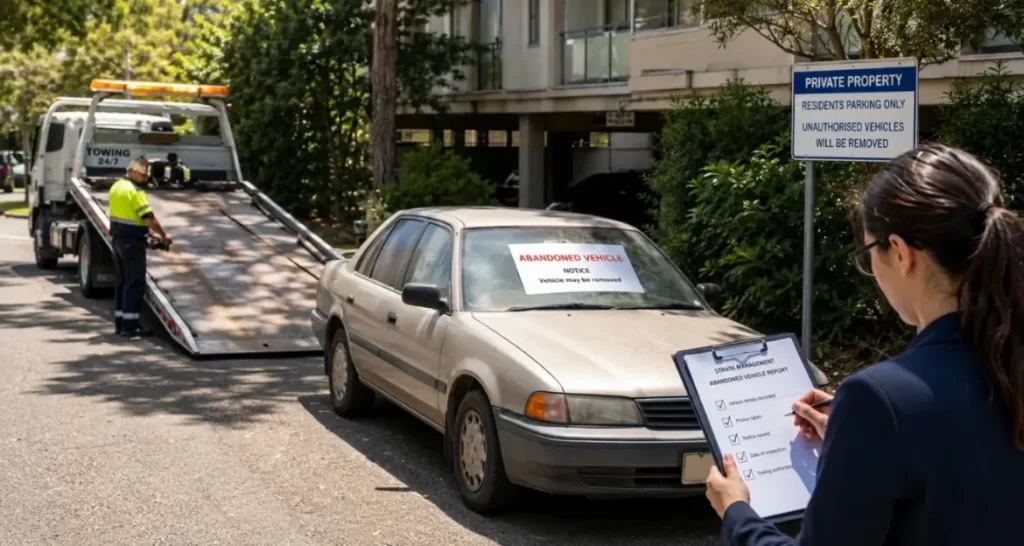
A clear sequence protects the strata scheme and gives the vehicle owner a fair opportunity to respond.
Step 1: Record the Vehicle and Its Location
Create a clear record showing:
- Make, model, colour and registration number
- Exact parking location
- Date first identified
- Visible condition or damage
- Flat tyres, leaks or missing parts
- Whether it blocks access or creates a hazard
Take dated photographs from several angles, including wider images showing the vehicle’s position. Confirm from the strata plan that it is located on common property.
Step 2: Make a Reasonable Effort to Find the Owner
Reasonable enquiries may include:
- Checking resident and visitor-parking records
- Asking residents whether they recognise the vehicle
- Contacting the owner, tenant or managing agent linked to the space
- Placing a notice on or near the vehicle
- Displaying a notice on the scheme’s noticeboard
- Sending written correspondence to a known interested party
Keep copies of all letters, emails, notices and responses. If the owner confirms the vehicle is still wanted, the issue may need to be handled as a parking or by-law matter instead.
Step 3: Assess the Value and Issue Notice
The vehicle’s estimated value affects the notice period and disposal method. The owners corporation should obtain a reasonable assessment based on its age, condition and likely market or scrap value.
The notice should identify:
- The vehicle and its location
- The owners corporation’s contact details
- Where the vehicle can be collected
- The collection deadline
- Any reasonable towing or storage charges
- The proposed disposal method
- What will happen if it remains uncollected
The vehicle may be moved to secure storage where appropriate, but moving it does not automatically authorise its sale or destruction.
Step 4: Complete the Required Motor Vehicle Checks
Before a vehicle is sold, the owners corporation may need to obtain:
- Confirmation that it is not recorded as stolen
- A Personal Property Securities Register search
- Available registration and identification details
- Information about any registered financial interest
If the vehicle appears suspicious or shows signs of tampering, contact NSW Police before moving it.
Step 5: Arrange Removal, Storage or Disposal
Once authority has been confirmed and the required steps completed, a suitable towing provider can move the vehicle.
Provide the operator with:
- Written towing authority
- Exact vehicle location
- Basement height and access restrictions
- Information about locked wheels, steering or brakes
- Details of damage or fluid leaks
- The approved storage or delivery destination
The owners corporation should retain photographs, notices, towing invoices, storage records, valuations, searches and disposal documents.
NSW Notice Periods and Disposal Options
The notice period and disposal method generally depend on the vehicle’s estimated value.
| Estimated Value | Minimum Notice | General Disposal Method |
|---|---|---|
| Less than $1,000 | At least 14 days | Appropriate disposal after the notice period |
| $1,000 to less than $20,000 | At least 28 days in writing | Public auction or private sale for fair value |
| More than $20,000 | As directed by NCAT | Disposal under an NCAT order |
Written notice is preferable in every case because it creates evidence of what was communicated and when the collection period ended.
For a low-value vehicle, appropriate disposal may include sale, recycling or transfer to an authorised dismantler. Vehicles in the middle-value category generally require a fair-value sale. High-value vehicles should not be disposed of without an NCAT order.
The disposal process should be paused if the owner responds, challenges the notice or provides evidence of ownership before disposal occurs.
Towing Costs, Sale Proceeds and Record-Keeping
Removing an abandoned vehicle may involve towing, storage, valuation, advertising and disposal costs. These expenses should be reasonable, itemised and supported by invoices or receipts.
The owners corporation may initially need to pay the service providers. Depending on the circumstances, reasonable costs may later be recovered from the owner or deducted from lawful sale proceeds.
Possible expenses include:
- Towing and loading
- Secure storage
- Valuation or inspection
- Advertising or auction fees
- Required checks and certificates
If the vehicle is sold, the sale record should show:
| Sale Record | Details |
|---|---|
| Gross proceeds | Total amount received |
| Towing and storage | Supported by invoices |
| Sale expenses | Valuation, advertising or auction costs |
| Total deductions | Combined permitted expenses |
| Remaining balance | Amount left after deductions |
Any remaining balance should be handled under the applicable NSW rules rather than treated as scheme income.
The owners corporation should keep one complete file containing the vehicle description, notices, photographs, searches, towing authority, invoices, sale documents and correspondence. Good records are particularly important if the removal or charges are later disputed.
Preparing a Strata Car Park for Towing
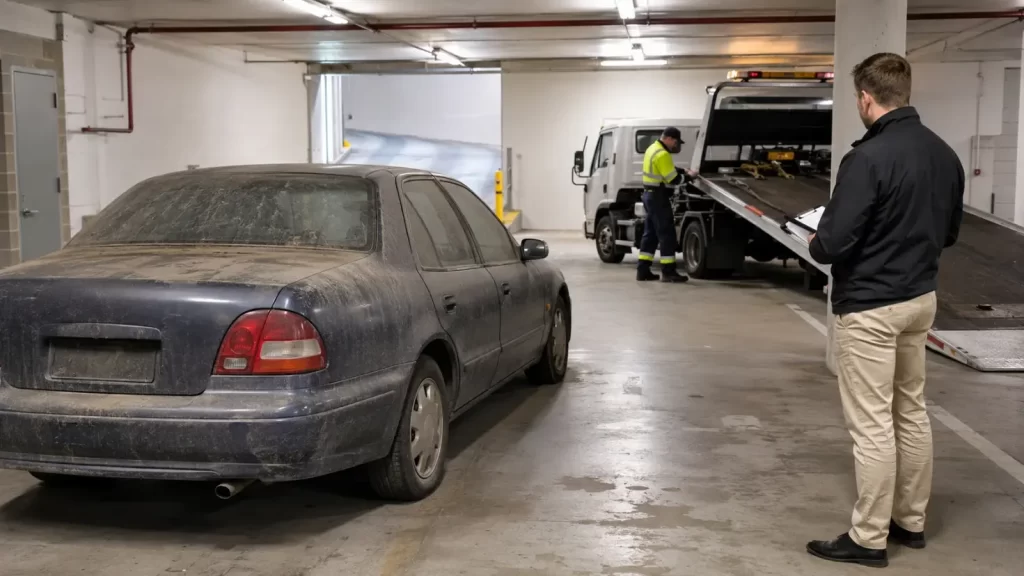
Good preparation makes an abandoned vehicle strata NSW tow easier to complete and reduces the risk of damage to the car, garage doors, walls or common property.
Important access details include:
- Basement entry height and width
- Ramp gradient
- Turning space
- Gate codes or remote access
- Nearby pillars or parked vehicles
- The safest exit route
The towing company should also know whether:
- Keys are available
- The vehicle can roll or steer
- Wheels or brakes are locked
- Tyres are flat or missing
- The vehicle is leaking fluids
- It is electric, hybrid, four-wheel drive or modified
Clear nearby vehicles where possible and arrange for an authorised strata representative to meet the operator. Photograph existing damage to the vehicle and common property before removal.
A standard tilt-tray truck may not fit inside a low-clearance basement. In restricted areas, wheel skates, dollies, winches or compact towing equipment may be required.
What If the Vehicle Is Blocking Access?
A vehicle blocking a driveway, garage entrance, loading area or access lane may require urgent attention. However, an obstruction does not automatically authorise immediate disposal.
| Type of Obstruction | First Response |
|---|---|
| Blocking another car space | Contact the owner and request prompt removal. |
| Blocking a shared driveway | Record the issue and begin parking enforcement. |
| Blocking a loading zone | Contact the owner and assess the urgency. |
| Blocking emergency access | Contact emergency services or NSW Police if there is immediate danger. |
| Abandoned but not dangerous | Follow the standard uncollected-goods process. |
Where possible, contact the owner immediately and place a written notice explaining the obstruction and the deadline for removal.
A vehicle may be obstructing common property without being abandoned. In that case, the owners corporation may need to enforce its registered parking by-laws rather than use the abandoned-goods process.
If an urgent safety risk exists, contact the appropriate authority and follow professional advice. Moving the vehicle to restore access is still different from selling or destroying it.
What Happens If the Removal Is Disputed?
A dispute may arise because the owner says the vehicle was not abandoned, notice was not received, the vehicle was removed from private property or the charges are excessive.
If the vehicle has not yet been disposed of, the owners corporation should consider pausing any sale, recycling or destruction while the claim is reviewed.
Review:
- Photographs and inspection notes
- Strata plans and by-laws
- Committee authority
- Notices and delivery records
- Valuation documents
- Police and PPSR checks
- Towing and storage invoices
- Sale or disposal records
The claimant should be asked to provide proof of ownership or another legal interest in the vehicle.
Where the vehicle remains in storage and ownership is established, it may be released after identity and authority are confirmed. Any dispute over charges should be handled separately and should not automatically justify disposal.
NCAT may be appropriate where ownership, authority, valuation, disposal or sale proceeds remain disputed.
When Should Strata Arrange Professional Towing in Sydney?
Professional towing should be arranged once the owners corporation has confirmed its authority and decided where the vehicle will be taken.
Towing may be required when:
- The notice period has expired
- The vehicle blocks common-property access
- It must be moved to secure storage
- The keys are unavailable
- The tyres, wheels or steering are damaged
- The vehicle cannot roll normally
- Basement access is restricted
- The vehicle is leaking fluids
- An order authorising removal has been obtained
A towing provider experienced with strata properties can assess low ceilings, tight ramps and restricted turning areas. Depending on the site, the vehicle may need to be moved with wheel skates, dollies or compact equipment before it can be loaded onto a tow truck.
The towing company handles the physical removal. The owners corporation remains responsible for confirming legal authority, notices and disposal requirements.
FAQ’s
Can an Owners Corporation Issue a Parking Fine?
An owners corporation generally cannot issue a parking fine in the same way as a council. It may issue a notice to comply with a valid by-law and apply to NCAT if the breach continues.
Can the Council Remove a Vehicle from a Strata Basement?
Usually not. A strata basement is generally private property. The owners corporation normally needs to follow the applicable strata and uncollected-goods process and arrange private towing.
Can a Tow Truck Move a Vehicle Without the Keys?
Often, yes. A towing operator may use a winch, wheel skates, dollies or other equipment. The absence of keys does not remove the need for proper towing authority.
What If the Owner Disputes the Disposal Notice?
The owners corporation should review the claim, check its records and consider pausing disposal. If the dispute cannot be resolved, the matter may be taken to NCAT.
What If the Vehicle Is in a Privately Owned Car Space?
The strata plan should be checked first. If the car space forms part of an individual lot, the lot owner should generally be involved before removal is arranged.
Do Missing Number Plates Prove That a Vehicle Has Been Abandoned?
No. Missing plates may justify further investigation, but they do not prove abandonment. If the vehicle appears suspicious, contact NSW Police before interfering with it.
Conclusion
An abandoned vehicle strata NSW issue should be handled with a clear record, reasonable owner contact, the correct notice and proper vehicle checks. The process depends on where the car is located, its estimated value and whether it needs to be moved into storage before disposal.
Once the legal and administrative steps are complete, professional towing can restore access to the property without turning a parking problem into a larger dispute.