Towing Capacity in Australia: How to Know What Your Vehicle Can Tow
Knowing how much your vehicle can tow involves more than finding one number in the owner’s manual. Vehicle weight, trailer mass, passengers, luggage, towbar ratings and the total combined load can all affect whether a towing setup stays within its limits.
When checking towing capacity Australia requirements, use the specifications for your exact vehicle rather than relying on a general figure found online. If a vehicle or load cannot be moved within its rated limits, using a professional Sydney towing service may be a safer alternative to attempting an unsuitable tow.
Understanding the main towing terms can make these limits much easier to check. This guide explains towing capacity, GVM, GCM, ATM, GTM, trailer brakes and the common factors that reduce the amount your vehicle can practically tow.
What Does Towing Capacity Mean in Australia?
Towing capacity is the maximum trailer mass a vehicle manufacturer specifies that a particular vehicle can tow. The figure can vary between models, engines, transmissions and drivetrains, even when the vehicles appear very similar.
A proper towing capacity Australia check should therefore consider more than the headline towing figure. Towbar capacity, trailer ratings, vehicle mass and component limits can all become the limiting factor.
Braked Towing Capacity
Braked towing capacity applies when the trailer has an appropriate braking system. It is normally higher than the vehicle’s unbraked towing limit because the trailer’s brakes contribute to stopping the combination.
Do not assume that having trailer brakes automatically allows you to use the vehicle’s maximum advertised towing capacity. Other limits such as GVM, GCM and towbar capacity still apply.
Unbraked Towing Capacity
Unbraked towing capacity applies when the trailer does not have its own braking system. Australian towing requirements place braking requirements on trailers according to their Gross Trailer Mass.
In NSW, trailers up to 750 kg GTM do not require brakes, while trailers above 750 kg GTM require an appropriate braking system. Trailers over 2,000 kg GTM require brakes on all wheels and an automatic breakaway system.
Understanding the Main Towing Weight Limits
Towing becomes confusing because several weight ratings apply at the same time. Staying below the vehicle’s advertised towing capacity does not automatically mean the entire setup is within its permitted limits.
When working out towing capacity Australia limits, check each applicable rating and work within the lowest restriction affecting your setup.
Gross Vehicle Mass – GVM
Gross Vehicle Mass is the maximum loaded mass permitted for the towing vehicle. It includes the vehicle itself plus passengers, luggage, accessories and other weight carried by the vehicle.
The downward load transferred from the trailer through the coupling also affects the load being carried by the tow vehicle. This is why adding passengers and equipment can reduce the available margin before reaching GVM.
Gross Combination Mass – GCM
Gross Combination Mass is the maximum loaded mass of the towing vehicle and trailer combination. It should not be confused with towing capacity because the two figures describe different limits.
NHVR guidance confirms that manufacturer GVM, GCM and individual component ratings must not be exceeded.
ATM and GTM
Aggregate Trailer Mass, or ATM, is a trailer rating relating to its maximum loaded mass. Gross Trailer Mass, or GTM, relates to the load carried through the trailer’s wheels when it is connected to the towing vehicle.
These figures should be checked on the trailer’s identification or compliance information. Do not rely only on the trailer’s empty or tare weight when planning a fully loaded trip.
Towing Capacity Ratings at a Glance
If a vehicle has been damaged in a collision and is no longer safe to drive, professional accident towing may be a more appropriate option than attempting to move it with an unsuitable vehicle or trailer.
Several different ratings can determine whether a towing combination is suitable. This table provides a quick reference for the main figures drivers should understand.
| Rating | What It Means | Where to Check |
|---|---|---|
| Towing capacity | Maximum trailer mass specified for the vehicle | Owner’s manual or manufacturer |
| GVM | Maximum loaded vehicle mass | Vehicle specifications |
| GCM | Maximum loaded vehicle and trailer combination | Manufacturer specifications |
| ATM | Maximum rated loaded trailer mass | Trailer plate |
| GTM | Maximum trailer mass carried through its wheels | Trailer specifications |
| Towbar rating | Maximum load permitted for the towbar | Towbar plate or label |
| Coupling rating | Maximum permitted coupling load | Coupling markings |
| Towball load | Permitted downward coupling load | Vehicle and towbar specifications |
The important point is that one high rating does not override another lower one. If your vehicle can tow 2,500 kg but the towbar is only rated to 2,000 kg, the higher vehicle rating does not make the towbar suitable for 2,500 kg.
If a car needs moving but cannot be transported within a suitable private towing setup, a professional car towing service can transport the vehicle without relying on another passenger vehicle to tow it.
How Vehicle Payload Affects Towing Capacity
Passengers and cargo can have a larger effect on towing capability than many drivers expect. A vehicle may have a high advertised towing rating while having limited remaining payload once it has been prepared for a trip.
When assessing towing capacity Australia, account for everything being carried in or fitted to the vehicle, including:
- Driver and passengers
- Luggage
- Tools
- Bull bars
- Roof racks
- Canopies
- Camping equipment
- Auxiliary batteries
- Recovery equipment
- Fuel
- Trailer coupling load
Accessories added after the vehicle leaves the factory still contribute to its actual weight. A heavily equipped 4WD may therefore have less available payload than an otherwise identical standard vehicle.
Why Towball Load Matters
A trailer places downward load onto the towing vehicle through the coupling. That load needs to be considered when checking the tow vehicle’s mass and manufacturer limits.
Avoid using one universal percentage as a substitute for the manufacturer’s specifications. Trailer designs vary, so the appropriate coupling load should be based on the vehicle and trailer requirements.
Why Tare Weight Can Be Misleading
Tare weight represents an unloaded condition and may be significantly lower than the actual travelling weight of a caravan, boat trailer or equipment trailer.
Water, food, luggage, tools, gas bottles and other equipment can substantially increase trailer mass. Checking the actual loaded configuration gives a much more useful picture than relying on tare weight alone.
Trailer Braking Rules and Towing Requirements
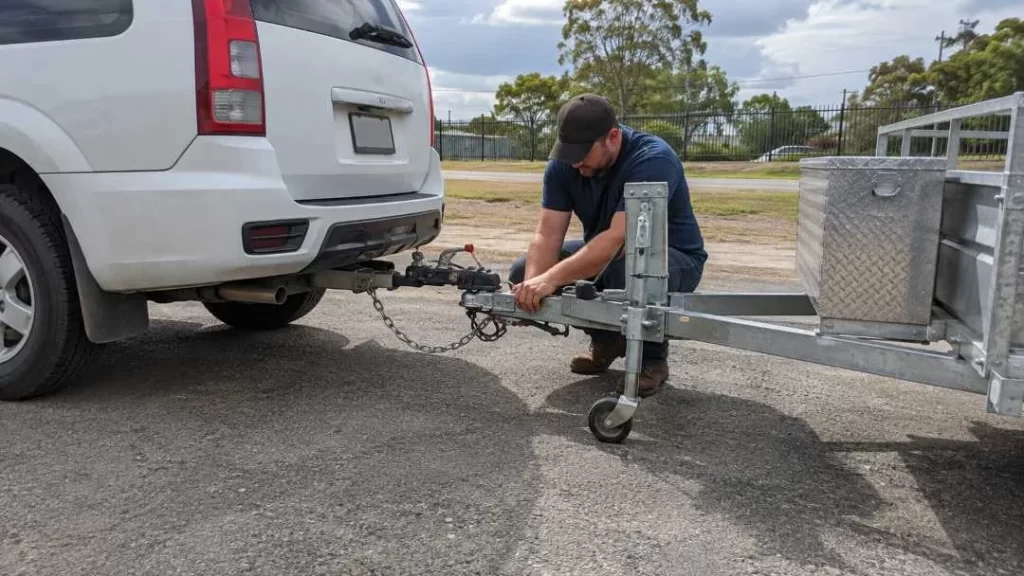
Trailer braking requirements are another important part of safe towing. The braking system needs to suit the trailer’s mass and comply with applicable vehicle standards and state road rules.
NSW Government guidance sets out the following general braking requirements for trailers:
- 0–750 kg GTM – brakes are not required, although fitted brakes must comply
- 751–2,000 kg GTM – braking is required on both wheels of at least one axle
- 2,001–4,500 kg GTM – braking is required on all wheels
- Above 2,000 kg GTM – an automatic breakaway system is required
Brakes alone do not make an overloaded trailer acceptable. Vehicle, trailer, towbar, tyre and coupling ratings must still be respected.
NSW Towing Rules
Drivers in Sydney should also consider NSW-specific towing requirements. NSW states that the loaded trailer mass must not exceed the lowest relevant limit applying to the vehicle, towbar and coupling, trailer, or tyres.
Towing rules can differ between jurisdictions, particularly around licence restrictions and road use. If you travel interstate, check the relevant state or territory transport authority before departure.
Towbars and Couplings
A towbar should be designed for the vehicle and rated appropriately for the trailer being used. A stronger-looking towbar does not automatically mean that it has a higher approved capacity.
NSW guidance also states that the rated capacity of the towbar and coupling should not be exceeded.
Bus and Motorcycle Towing
Different vehicle types require different towing equipment and loading methods. Size, weight, wheel configuration, ground clearance and vehicle condition can all affect how a vehicle should be transported safely.
Buses and other large passenger vehicles require equipment capable of handling their greater dimensions and weight. If a bus cannot be driven safely because of a breakdown or mechanical problem, professional bus towing can provide a suitable transport option based on the vehicle’s size, condition and location.
Motorcycles require a different approach because they need to remain stable and securely restrained during transport. Professional motorcycle towing can help move a bike that has broken down, has a flat tyre or cannot be ridden safely without relying on unsuitable loading methods.
Common Towing Capacity Mistakes to Avoid
Most towing capacity errors occur because one figure is considered in isolation. A vehicle’s maximum braked towing number may look suitable even when another important rating has already been exceeded.
Common mistakes include:
- Checking towing capacity but ignoring GCM
- Exceeding GVM after adding passengers
- Using the trailer’s tare weight instead of loaded weight
- Ignoring towbar capacity
- Confusing ATM and GTM
- Forgetting accessories added to the vehicle
- Ignoring towball load
- Assuming suspension upgrades increase towing capacity
- Using specifications from a different vehicle variant
- Failing to check trailer brakes
- Assuming towing requirements are identical across Australia
A better approach is to check every relevant rating before departure. If one number is unclear, confirm it rather than estimating.
Can Modifications Increase Towing Capacity?
Fitting heavy-duty suspension, stronger springs or a higher-rated towbar does not automatically increase the towing capacity specified by the vehicle manufacturer. A modification may improve certain components while other vehicle or combination limits remain unchanged.
Changes to recognised vehicle mass ratings can involve engineering and registration requirements. Before relying on an increased towing figure, confirm that the modification is legally recognised for the exact vehicle and does not cause another rating to be exceeded.
The same principle applies to tyres, wheels and suspension components. NHVR guidance makes clear that manufacturer component ratings must also remain within their applicable limits.
When Should You Weigh Your Vehicle and Trailer?
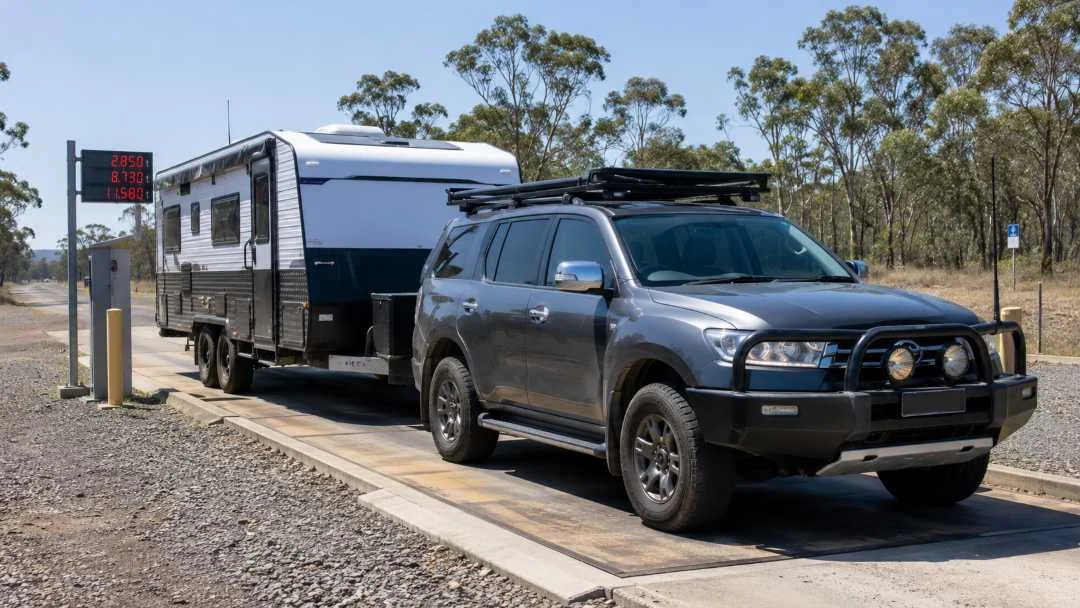
Manufacturer specifications tell you the maximum permitted ratings, but they do not tell you what your vehicle and trailer actually weigh on the day of travel. Weighing can therefore be useful when a combination is close to one or more limits.
Ideally, weigh the setup in its normal travelling condition, including passengers, fuel, luggage, water and camping equipment. Accurate public weighbridge readings can help you compare the actual loaded weight with the vehicle and trailer limits.
The results can then be compared with:
- Vehicle GVM
- GCM
- Trailer ATM
- Relevant axle ratings
- Towbar limits
- Tyre ratings
- Manufacturer requirements
A weighbridge measurement does not replace the manufacturer’s ratings. It simply helps establish the actual loaded mass so those figures can be compared properly.
Frequently Asked Questions
How Do I Find My Vehicle’s Towing Capacity?
Check the owner’s manual or official manufacturer specifications for your exact model, engine and drivetrain. You should also check GVM, GCM and the ratings of the towbar and trailer.
What Is the Difference Between Braked and Unbraked Towing Capacity?
Braked towing capacity applies when the trailer has an appropriate braking system. Unbraked towing capacity applies to trailers without their own brakes and is normally much lower.
Is Towing Capacity the Same as GCM?
No. Towing capacity relates to the maximum trailer mass specified for the vehicle, while GCM limits the total loaded mass of the towing vehicle and trailer combination.
Does Towball Weight Count Towards Vehicle Load?
Yes. The downward load applied through the towball contributes to the load carried by the towing vehicle and needs to be considered when checking its mass limits.
Can I Tow at My Vehicle’s Maximum Towing Capacity?
Possibly, but the advertised towing capacity is only one limit. GVM, GCM, towbar capacity, trailer ratings, payload and other component limits must also remain within their permitted values.
Do Trailers Over 750 kg Need Brakes in Australia?
Australian vehicle standards require trailers above specified mass thresholds to have suitable braking systems. The exact requirements depend on trailer mass, so current Australian and state-specific rules should be checked before towing.
Can Modifications Increase My Vehicle’s Towing Capacity?
Fitting stronger suspension or a higher-rated towbar does not automatically increase the manufacturer’s towing capacity. Any recognised increase may require engineering approval and must still comply with other vehicle and component limits.
What Happens If I Exceed the Towing Capacity?
Exceeding towing or mass limits can place extra stress on the tyres, brakes, suspension and drivetrain. It can also make the vehicle-trailer combination less stable and potentially put it outside legal or manufacturer limits.